
University of Warwick (UK): Degree Advantages and Academic Disciplines
The University of Warwick is situated near the city of Coventry in the English Midlands. Its main campus is located in the Gibbet Hill and Westwood areas on the outskirts of Coventry—approximately 3.5 miles (5.6 km) from the city center—and lies adjacent to a key industrial and logistics hub within the UK. This strategic location fosters strong linkages with core enterprises across the manufacturing, automotive, retail, and supply chain sectors; for instance, the university has established deep, long-term partnerships with global industry leaders such as Jaguar Land Rover, Tesco, Unilever, Amazon, and DHL. University of Warwick diploma sample, University of Warwick certificate example.
As a public research university, the University of Warwick—despite its relatively short history (founded in 1965)—has experienced rapid growth. It is now a proud member of the UK’s prestigious Russell Group and consistently ranks among the top institutions in the global higher education landscape. According to the latest authoritative rankings:
– It is ranked 74th in the 2026 QS World University Rankings;
– It is ranked 122nd in the 2026 Times Higher Education World University Rankings;
– It is ranked 182nd in the 2025 U.S. News & World Report Best Global Universities Rankings;
– It falls within the 101–150 band globally in the 2025 Academic Ranking of World Universities (ARWU).
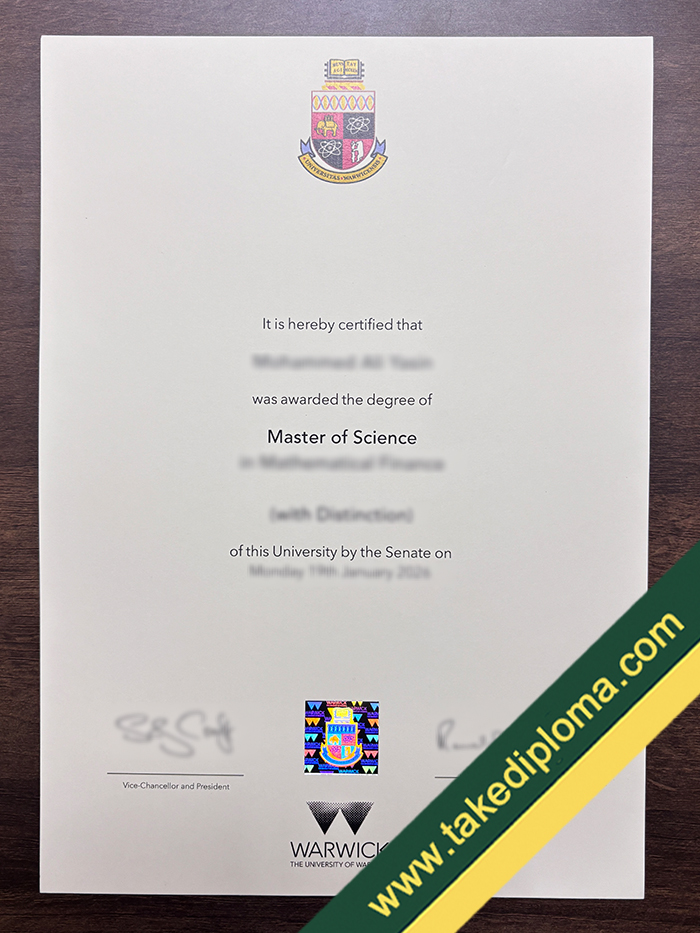
Notably, the university demonstrates a distinct “structural advantage” in its academic strengths, with particular prominence in the fields of Management, Economics, Engineering, and Logistics & Supply Chain Management. Taking the Master’s program in Logistics and Supply Chain Management as a prime example, the curriculum is designed to deeply integrate business logic with technological tools. It covers cutting-edge modules such as supply chain finance, global logistics network optimization, data analytics, procurement strategy, sustainable logistics, and risk management. The program places a strong emphasis on practical application; students not only utilize on-campus supply chain laboratories and logistics simulation systems for hands-on training but also participate directly in real-world projects initiated by companies like DHL and Amazon, gaining access to highly relevant internship opportunities. Furthermore, thanks to its location in the Midlands—the traditional heartland of British manufacturing—the University of Warwick has established a “closed-loop ecosystem” of industry-academia collaboration with regional industrial clusters. On one hand, this geographical proximity significantly shortens the response cycle for university-enterprise collaboration; on the other, real-world industrial scenarios continuously feed back into curriculum development, ensuring that talent cultivation remains closely aligned with evolving industry trends—such as the currently high-profile areas of green supply chain transformation, AI-driven demand forecasting, and the construction of resilient supply chains.